
Text and photos by Peter Mann

St Denis’ is to be saved – our original story on SCDC coming to the rescue.
The Church of St Denis, East Hatley is a Grade II* listed building. It was probably built in 1217 – the majority of the surviving fabric in the nave is from the 14th century.
In 1874 William Butterfield, the notable 19th century architect, carried out substantial restoration work, renewing the roof and floor, replacing box pews with a more inclusive arrangement for all worshippers, moving the pulpit, installing heating, redesigning and enlarging the chancel and adding a vestry.
He used the original medieval roof timbers as the supports for the floor – they are still there, albeit now under the new floor laid in 2018, but visible when the inspection hatches in the nave are lifted.
The church was last used for worship in 1959 and, in order to prevent its demolition by the Diocese, ownership was conveyed by the Church Commissioners to South Cambridgeshire District Council on 15th October 1985.
The churchyard, which remains open for burials, is a County Wildlife Site and a designated Local Nature Reserve; regular tidy-ups to keep it in good shape.
In a terrible state
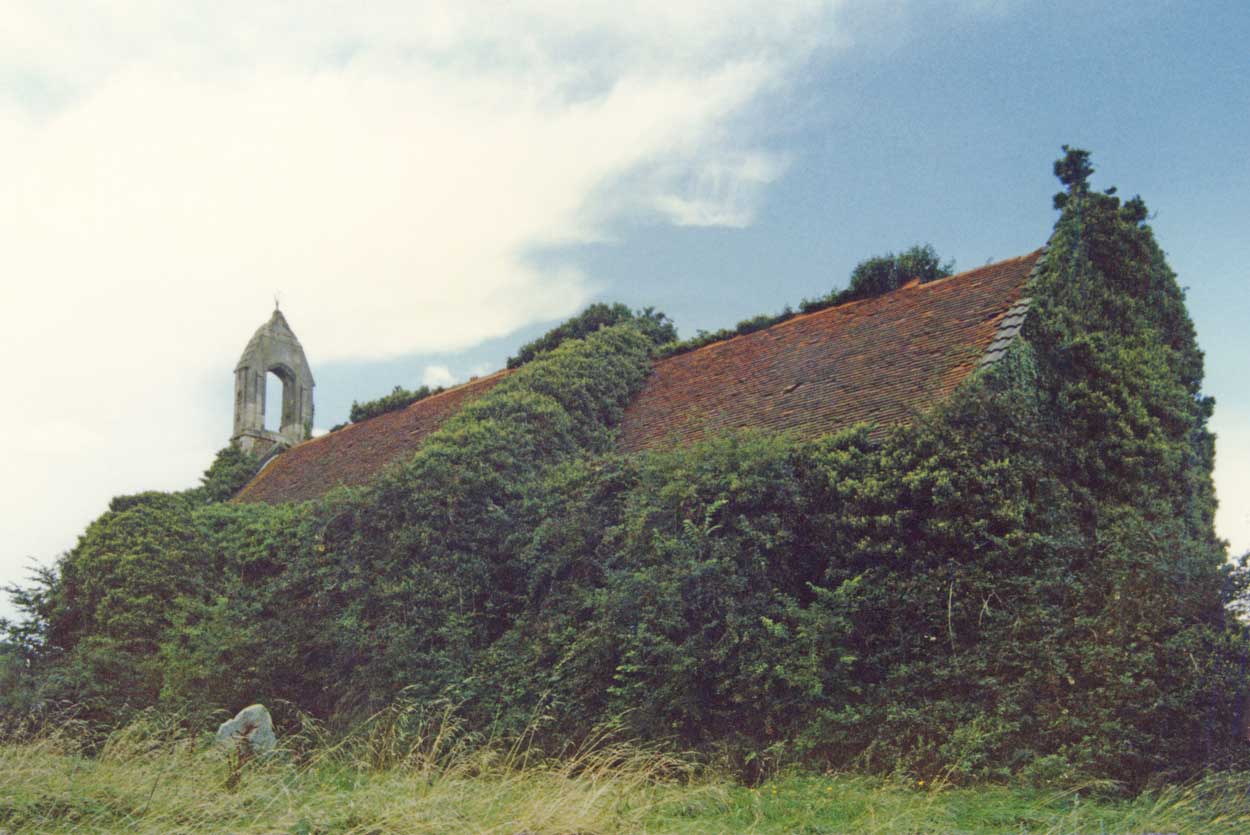
St Denis’ church in 2002 when the whole building was in great danger of collapse.
By 2002, high winds and overgrowth of ivy had caused significant damage to the roof and walls of the church, such that some parts of the structure were deemed unsafe. Practically everything on the inside had been ripped out – there was no glass in the windows and the whole building was in great danger of collapse.
In early 2003, SCDC appointed E Bowman and Sons to remove the ivy in order to survey the building. This enabled the Council to commission the architects Purcell Miller Tritton to inspect the building. Their report, received in November 2003, did not paint a happy picture.
At this point, the Council was ‘minded’ to let the building fall into complete disrepair. It was referred to SCDC’s Scrutiny Committee and on 11th March 2004 I was able to put the case for saving St Denis’ on the very straightforward basis it was a listed building – and as the local authority with powers to ensure owners of listed buildings keep them in good repair, SCDC was hardly setting a good example. Item four in the Scrutiny Committee’s minutes summarises my discussion.
At risk
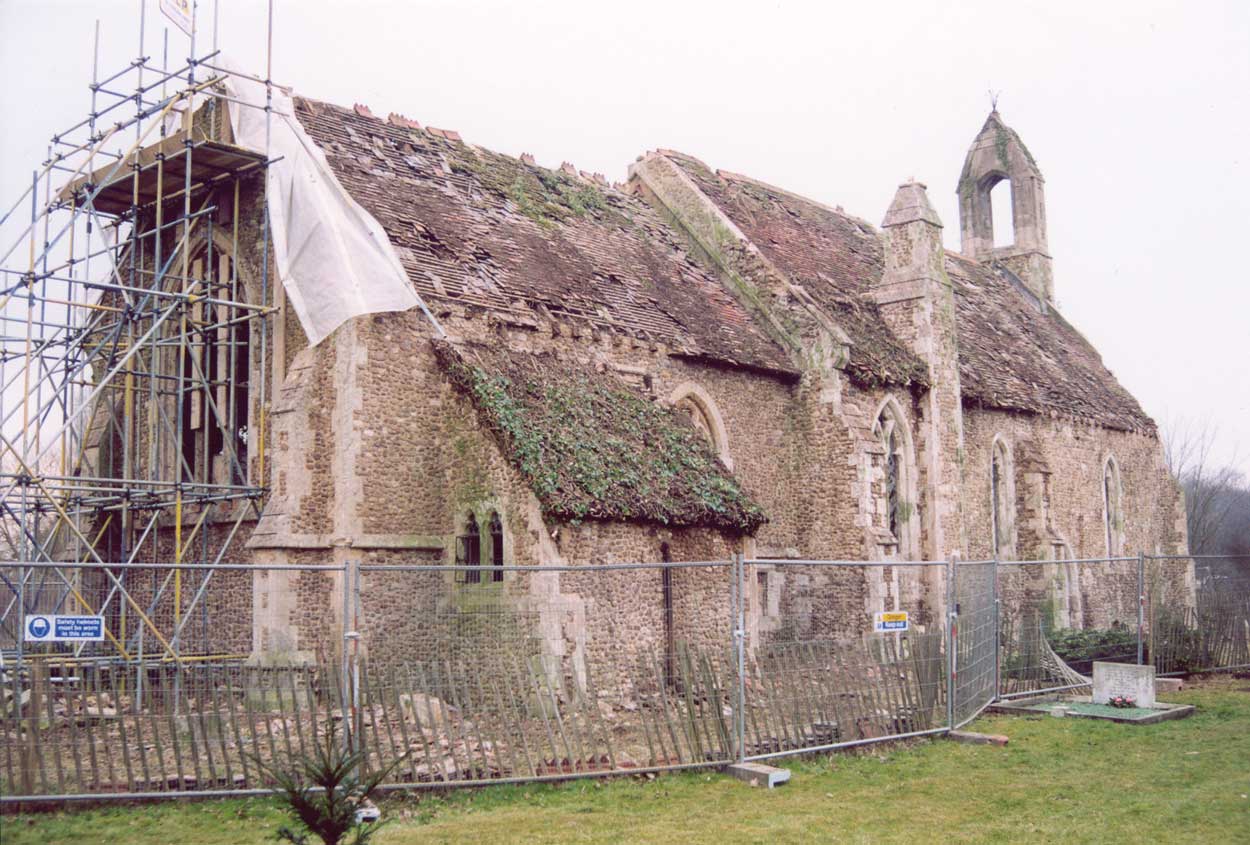
St Denis’, February 2003 after the ivy had been removed showing what a terrible state it was in.
Severe damage was found to part of the external walls with the gable ends unstable and in danger of collapse. The roof tiles were insecure, while the removal of the ivy had affected the integrity of both the roof and the walls, leaving many of the tiles loose and much of the flint stone facing in a decayed condition.
In June 2004 the church was placed on the Heritage at Risk register for Grade I and II* buildings, maintained by Historic England – it was removed from the register in 2015 (hooray!).
At a meeting on 9 June 2005, the SCDC Cabinet accepted the recommendation of its Conservation Advisory Group that a tender of £151,000 for the church to be made safe with a clay tile roof be accepted, rather than an alternative tender for £110,000 for it to be repaired with a corrugated iron roof – which Hatley Parish Council, encouraged by a public meeting, was wholly against.
The Cabinet authorised the work to be funded by grant support from English Heritage (£61,000), Hatley Parish Council (£2,000 conditional on the roof being tiled rather than covered in iron sheets) and SCDC’s Historic Buildings Conservation Fund.
Much scaffolding
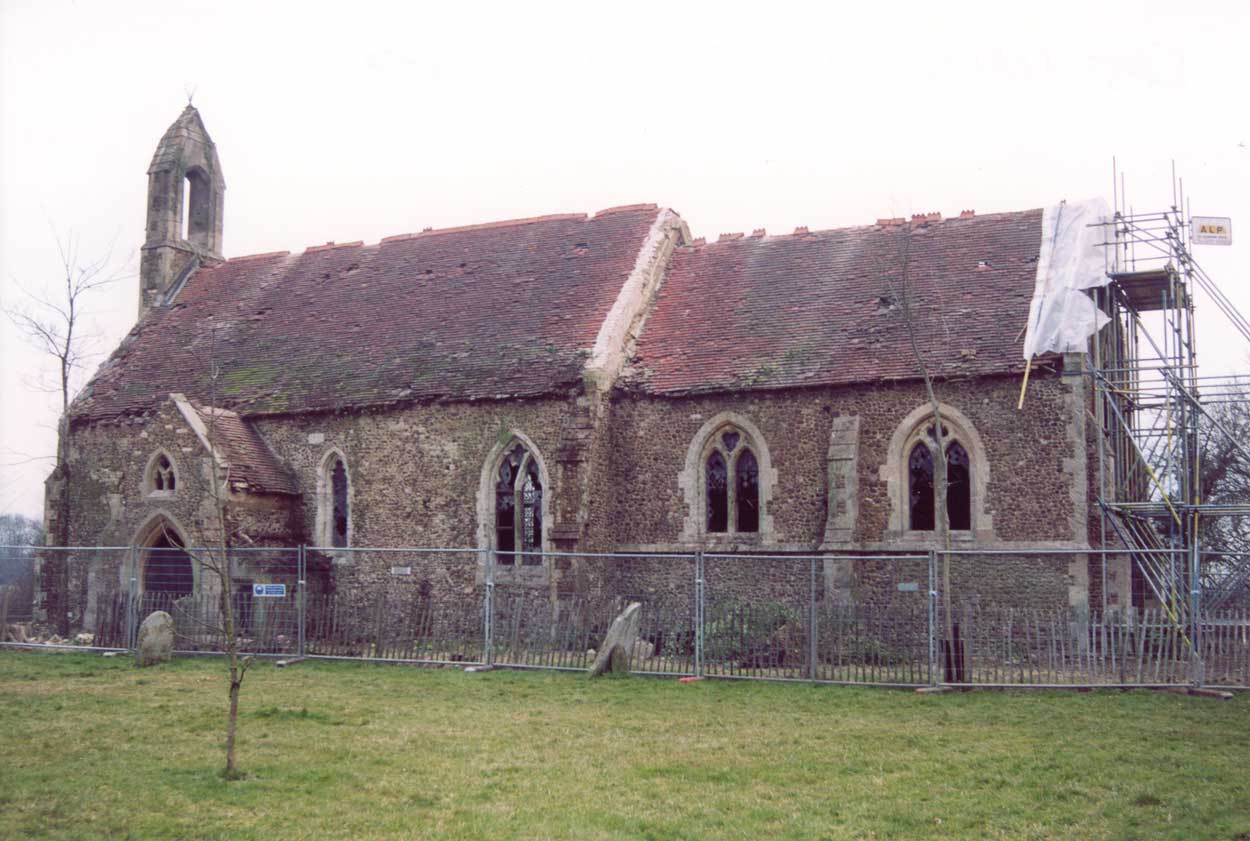
Fortunately, St Denis’ was only this bad.
Haymills Conservation was appointed in July 2005 to repair the damaged stonework, undertake repairs to the roof timbers and re-tile the roof. Work began on 1 August 2005 – soon the church was surrounded by scaffolding and the tiles removed.
By October 2005, the stonework was substantially complete and timber repairs were undertaken. Haymills finished its work in January 2006, leaving St Denis’ as a ‘safe shell’ with its roof re-tiled and timbers and stonework repaired thanks to the care, hard work and professionalism of Haymills’ expert craftsmen.
Credit for getting the restoration of the building to happen must go to Nick Grimshaw, SCDC’s Conservation Manager at the time, who championed our cause most admirably, and, of course to the cabinet members of SCDC for reaching what must have been a difficult decision in the financial climate for the council in 2005.
But what now?
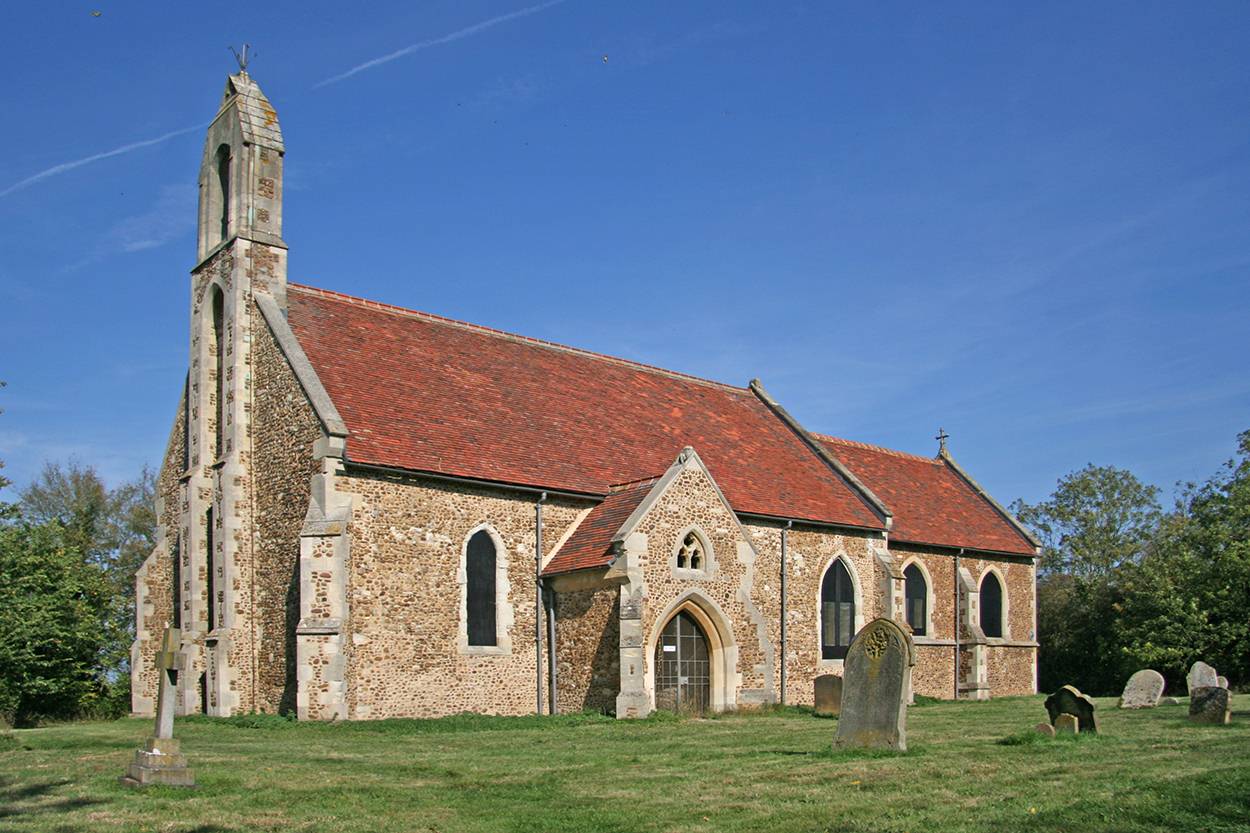
St Denis’ looking good – 2nd October 2011.
With the exterior restoration complete, pictured left, the next step was to secure further grant support to complete restoration of the inside of the church with windows and a new floor to enable the building to be utilised for an appropriate community purpose – a scheme was expected to be developed in consultation with the parish during 2007, but came to nothing.
The building remained in SCDC’s possession – and a thorn in its side, as a report in late 2012 showed: could it be sold?
Thanks to the efforts of David Bevan, who followed Nick Grimshaw as SCDC’s Conservation Manager, discussions took place with a number of conservation bodies, with the Friends of Friendless Churches showing real interest, not least because of the Butterfield connection, the FoFC not then having any examples of his work in its portfolio of 47 churches (it now has 60, including the recent acquisition of St Giles’ in Tadlow, another Butterfield restored church).
And who pays?
The ‘only’ stumbling block was money, the FoFC being reluctant to take on the church without a substantial dowry.
Sebastian Kindersley (then our District Councillor) and myself met with Ray Manning, at the time Leader of SCDC, on 8th October 2013 to push the point if the building were sold, particularly via auction, the hidden costs to SCDC of fighting any untoward planning applications will be much greater than conveying it to the FoFC with a dowry – specifically the £60,000 the council had in a ‘historic building’ reserve.
After three years of toing and froing between SCDC, the FoFC and various lawyers, FoFC took possession on 30 November 2016; in June 2017, it applied for planning permission to do the basics: installing a floor and windows in the nave, replacing the door in the vestry and making minor repairs.
The work was paid for by that dowry, supplemented by funds raised by local residents, grants from Hatley Parish Council and Gamlingay and Hatley Parochial Church Council, a generous donation from the family of a relative buried in the churchyard and the FoFC’s own reserves.
Since then, two other restoration projects – in 2021 (consolidation of the plaster and new windows in the chancel) and, more especially in 2022, with replastering several sections of the nave – leave only a new east window as the last major project still on the ‘to do’ list.
From useless to useful
The investment the FoFC has made in St Denis’ after taking ownership (upwards of £300,000, largely from public funds as well as its reserves), has taken St Denis’ the full circle from useless to useful, from a safe shell without floor or windows and permanently closed to a wonderful building which is now open daily (from 8.30 am to dusk).
It has restored and preserved the inside to something Butterfield would recognise and allows the local community to decide how best to use a significant space. Two Taizé services, in 2011 and 2012, revealed the wonderful acoustics of the building.
Without doubt, thanks to sensible decisions at SCDC in 2002/3 and again in 2013/14 and the enthusiasm of the FoFC, St Denis’, East Hatley, has a very bright, safe and secure future. We are very fortunate – as a community we need to show our gratitude by looking after it and using it, for it is more than a static museum.
Further information
As the previous owners of St Denis’ church (the building, not the graveyard), SCDC has numerous documents and reports – available via its website, but as of January 2020, searching for ‘St Denis’ church East Hatley’ no longer produces any relevant results.
Fortunately, we had already copied the links to he main documents listed below – they go directly to the SCDC website but can take a while to appear.
- 2002 to 2012 SCDC’s records on St Denis’ church – details, history, decisions and meetings from 2002 to 2012.
- 2003 SCDC results of architect’s investigation – 28th May 2003.
- 2004 Minutes of the SCDC Scrutiny Committee meeting, 11th March 2004 (see item four on page three).
- 2004 SCDC report to arrest deterioration – 15th September 2004.
- 2005 SCDC report to arrest deterioration – 9th March 2005.
- 2005 SCDC Appendix / tender – 7th June 2005.
- 2005 SCDC report on the tenders – 8th June 2005.
- 2005 SCDC Appendix / tender approval – 9th June 2005.
- 2005 Historic building recording – December 2005 [4 MB file].
- 2012 Briefing for Local Management Group – 11th May 2012.
- 2012 The future of St Denis’: the relevant pages of SCDC’s Portfolio Holder’s meeting report – 18th December 2012 (start on page four).
- 2014 SCDC agree to give St Denis’ church to the Friends of Friendless Churches – 20th March 2014.
- 2017 Heritage impact assessment, March 2017, by Sally Humphries and Colin Staff, Purcell Miller Tritton LLP, submitted to SCDC.
- 2017 The phase one internal and external repair schedule / specification, March 2017, by Stephanie Norris and Colin Staff, Purcell Miller Tritton LLP, submitted to SCDC.
- 2017 Copy of the application for planning permission , April 2017 submitted by FoFC to SCDC – it contains drawings and other relevant details (and is a 12.6 MB file).
- 2017 FoFC’s planning application – reference S/1701/17/FL dated May 2017 on the SCDC website (Greater Cambridge Shared Planning: a strategic partnership between Cambridge City and South Cambridgeshire District Councils).
- 2017 Historic England comments, June 2017 – letter from Sheila Stones, Inspector of Historic Buildings and Areas, Historic England’s East of England Office, to Rebecca Whitney, South Cambridgeshire District Council.
Background articles
In addition to the first link (to our main St Denis’ church page), we’ve included links to older articles detailing how the building went from a ruin its then owners (South Cambs District Council) wanted to demolish to its very bright future:
- St Denis’ East Hatley – 800 years old: redundant but not abandoned.
- It’s to be saved – the 2005 commitment by South Cambridgeshire District Council to restore not demolish St Denis’ church.
- FoFC’s acquisition – the Friends of Friendless Churches acquire St Denis’ church.
- The next chapter – the Friends of Friendless Churches’ first planning application (in 2017) to kick-start their project of restoring the interior of St Denis’.
- St Denis’ re-skinned – new plaster gives new life to 800 year old church.
- Photo gallery – celebrating handing over St Denis’ church keys to the Friends of Friendless Churches by South Cambridgeshire District Council in July 2017… and other events.
- St Denis’ in the news – press cuttings from our open days and evenings.
- Heritage Open Days festival 2019 – how it was for St Denis’ church.
- A little less of St Denis following the devastating fire at Notre Dame Cathedral in 2019.
- Who was St Denis? – more than just a 3rd-century Christian martyr.
- The Say rectors of East Hatley – They gave over 112 years of service to the parish.
- Flyer – A4, 2pp leaflet about St Denis’, October 2023.
- Visitor guide leaflet – 39 things about St Denis’ / A5, 4 pp, October 2023.
- 360° view – by Alex Brad, 360 Deaneries, 3rd July 2022. NB It opens to a Facebook page.
- Video [1] – by Churches of the Past / June 2022. It captures the ambiance and atmosphere of St Denis’ – and the wildlife around the church.
- Video [2] – by Village and Town History / September 2021. It puts St Denis’ in context with other historical events. It was made before the nave and chancel were given a new coat of plaster and lime wash in spring 2022.
- St Denis’ churchyard – a ‘living’ churchyard and nature reserve.
- Nature in the churchyard – the nature reserve at St Denis’ church.
Listed buildings
Buildings are graded to show their relative architectural or historic interest:
- Grade I buildings are of exceptional interest.
- Grade II* are particularly important buildings of more than special interest.
- Grade II are of special interest, warranting every effort to preserve them.
Listing currently protects 500,000 or so buildings, of which the majority – over 90% – are Grade II. Grade I and II* buildings may be eligible for English Heritage grants for urgent major repairs.
Historic England has a National Heritage List for England on its website – put your postcode into the search box or use this link to go directly to East Hatley.
- SCDC has a section on its website on its policy for listed buildings, called Supplementary Planning Documents (SPDs).
Friends of Friendless Churches – the owners of St Denis’
“We are,” they say, “a very small charity which saves redundant historic churches.
“We now own 60 former places of worship, half in England, half in Wales, which we preserve as peaceful spaces for visitors and the local community to enjoy. Most are medieval, and all of them are listed.”
To become a ‘Friend’, the annual individual membership is £30.00 and ‘Household’ £50.00; life membership is £1,000. Membership includes two, very informative 60+ page magazines each year about the FoFC’s activities in England and Wales – and much else.
- Friends of Friendless Churches website.
- Join the FoFC – the best way to support its work.
- Follow the FoFC on Instagram, Facebook, Twitter and LinkedIn.